On the iPhone, Encryption, & Our Right to Privacy

unnamed

I paid my credit card bill on Monday using my iPhone. On Sunday, I filed my taxes from my iPhone. Smartphones are now ubiquitous hubs of shopping, banking, and finance for even the most non-tech savvy users. We are able to do this securely and safely through encryption, which protects data from theft, surveillance, and other nefarious deeds.

On Tuesday evening, word came out that a judge in the San Bernardino terrorist attacks demanded that Apple unlock the iPhone 5c of a shooting suspect. This comes after Apple steadfastly refused to put a backdoor of any sorts into its devices, fearing the same method used by authorities could be used by hackers and other data thieves.

In response, Apple CEO Tim Cook released a open letter on the company’s website, not unlike what his predecessor, Steve Jobs, did in April 2010. Cook explains in his response the need for encryption, while simultaneous recognizing the tragedy in San Bernardino.

Cook warns encryption skeptics of the dangerous consequences that a backdoor into iOS devices could cause. Cook wrote:

The government would have us remove security features and add new capabilities to the operating system, allowing a passcode to be input electronically. This would make it easier to unlock an iPhone by “brute force,” trying thousands or millions of combinations with the speed of a modern computer.

Even though technology advocates and experts recognize the utility and importance of encryption, the people who regulate the laws on which we must abide are simply ignorant. As Cook said, the FBI’s intentions are mostly likely in the right place, but are nonetheless ill-advised.

Possibly the most damaging aspect of this controversy is who and how the conversation of encryption is being brought to the public eye. We’ve reached the point where quasi-influential political figures (read: presidential candidates) have come out in favor of disabling encryption.

GOP presidential candidate Donald Trump openly sided with the abolishment of full encryption like Apple does during Fox & Friends interview, saying “Who do (Apple) think they are? They have to open it up.”

For people outside of the tech bubble, comments like Trump’s will be their first exposure to encryption. They will make the false conclusion that supporting encryption is equivalent to supporting ISIS. They will believe encryption is anti-American. They will take all of this asinine talk for truth as their privacy and digital security goes by the wayside.

It doesn’t matter whether you love Apple or hate them at the moment. This isn’t about preferences for Apple, Windows, Android, or whatever operating platform. This is about all of us and our security, and protect it, Apple and the rest of Silicon Valley must fight the good fight.


On David Bowie

Bowie.gif

GIF created by Helen Green 

I woke up at about six this morning and checked my phone, like I do any other morning. Unfortunately, for the third time in the past month-and-a-half, I learned an iconic singer’s death.

As I scrolled through Twitter and Google News, David Bowie’s death began to make sense, as much as the passing of a lauded artist can.

Bowie released the video for “Lazarus” last week, on the day of his 69th birthday. The video and animations that accompanied the album’s promotional material were a tad creepy, but undoubtedly Bowie. From Bowie’s gaunt figure levitating over his bed to the title of the album, Bowie left hints of his illness and imminent passing in his final work.

Bowie’s social media team shared GIFs of his transformation during his career, from Ziggy Stardust to Labyrinth. Seeing Bowie’s different iterations of himself made me marvel at his longevity in music business, a function of the shown ability to reinvent himself.

I sat in bed reading posts from my favorite musicians mourning the loss of Bowie, and I couldn’t help but find peace in the way David Bowie left this life.

Not unlike his career, Bowie’s handling of his death was on his own terms, an artful performance piece that was undeniably from the mind of the man who made generations care about something abstract as “Ziggy Stardust & the Spiders from Mars.”

Why I am dumping my Galaxy S5 for an iPhone 5s

My dad broke his glasses a couple years ago. As he bent them, bragging about their flexibility and strength, they snapped like twigs underfoot.

I am my father’s son.

As we ate dinner at Applebee’s on Saturday night, I bemoaned the awful fingerprint sensor on my year-old Galaxy S5 to my brother. I decided to show him how non-functional the features was. Boy, did I ever.

The phone wouldn’t recognize my fingerprint, giving me a prompt to enter a backup password after several failed attempts. The only problem with the backup password was I didn’t set it. Maybe I set up a password when I originally got the phone last November, but it hadn’t been used since I first determined the worthlessness of the fingerprint scanner.

Panic set in as my phone began counting failed attempt that would reset my phone to its original factory setting. I decided I would deal with it once we got home, where I have more tech support options at hand.

Unfortunately, my phone registered several more phantom attempts in my pocket during the car ride home.

Everything was gone. Everything. My game of Fall Out Shelter, my pictures, and just about everything else I’d accumulated in a year’s worth of usage.

It didn’t get any better from there.

The factory reset deleted not only the internal storage on my phone, but the 32 GB worth of external storage I had on an external micro SD card. It was gone.

How this deters theives, I’ll never know. “Hey if you put in the wrong password enough times, we’ll wipe the phone for you and you’ll be good to go!”

I’d dealt with a similar issue weeks before I got my S5 while using my old S3, the worst device I’ve ever used. Months of pictures gone, including family trips and the Indianapolis 500, and I still decided to buy a newer version of the phone a few weeks later.

After losing a good portion of my digital content for the second time in the span of the year, I immediately threw in the towel with my experimentation with Samsung and Android. For all of the “innovative” features those devices include, there are another five headaches ready to negate any technological gain.

The decision for my replacement was easy. In my almost ten years of buying consumer electronics, my favorite far and away was my iPod Touch. It did it’s job as well as any device I’ve owned before or since. Unfortunately, it was not grandfathered into iOS 7’s release, rendering many of my apps obsolete. Since I was interested in the Android and Galaxy platform due to peer pressure from some woefully misguided friends, I replaced my iPod with a StraightTalk Galaxy S3, one of the most pathetic electronic devices know to men.

My main hope for the iPhone 5s that will become my daily driver by the end of the week is that it will be a good stop-gap solution. I have a little more than a year left on the Verizon contract I signed to buy my Galaxy S5, and Lord knows how much (more) grey hair I’d have if I tried to run out the clock with that device.

I need the iPhone 5s to last until my upgrade next November, when I’ll undoubtedly buy an iPhone 7, should my financial situation permit.

Maybe the deletion of all my files was a blessing in disguise to get me out of the Android system, something I’d been trying to do for the past several months. Still, I wish it could’ve been a less acrimonious ending.

A Quick Windows 10 Review

Windows10Desktop
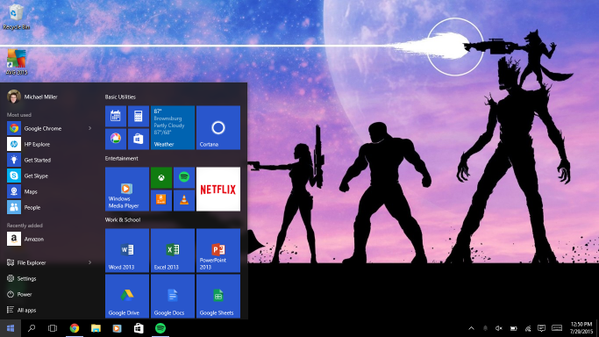
My Windows 10 homescreen, less than 12 hours old. You know you love the Guardians of the Galaxy wallpaper

During the wee hours of July 29, I sat eagerly at my laptop as the freshly released Windows 10 operating system made its way onto my device.  Within an hour of the Windows update icon appearing on the taskbar, I bid adieu to Windows 8 and its foibles as I greeted Windows 10 and the long-lost start menu it brought with it.

The M.O. of Windows 10 is to be best version of the Windows operating system, as were its predecessors with varying success. I loved Windows 7 and its functionality, and was lukewarm to Windows 8 despite its pleasing aesthetics. Microsoft made a play to please fans of both editions. Fortunately, Windows 10 succeeds in its aim of being the best of both worlds.

The most obvious improvement is the aforementioned return of the start menu. Simple and elegant, the Windows 10 start menu provides a UI that informs the user while remaining practical. If for some reason you still prefer Windows 8’s full-screen tile interface to a traditional start menu, tablet mode is easily accessible and admittedly better than Windows 10’s start screen.

Task View
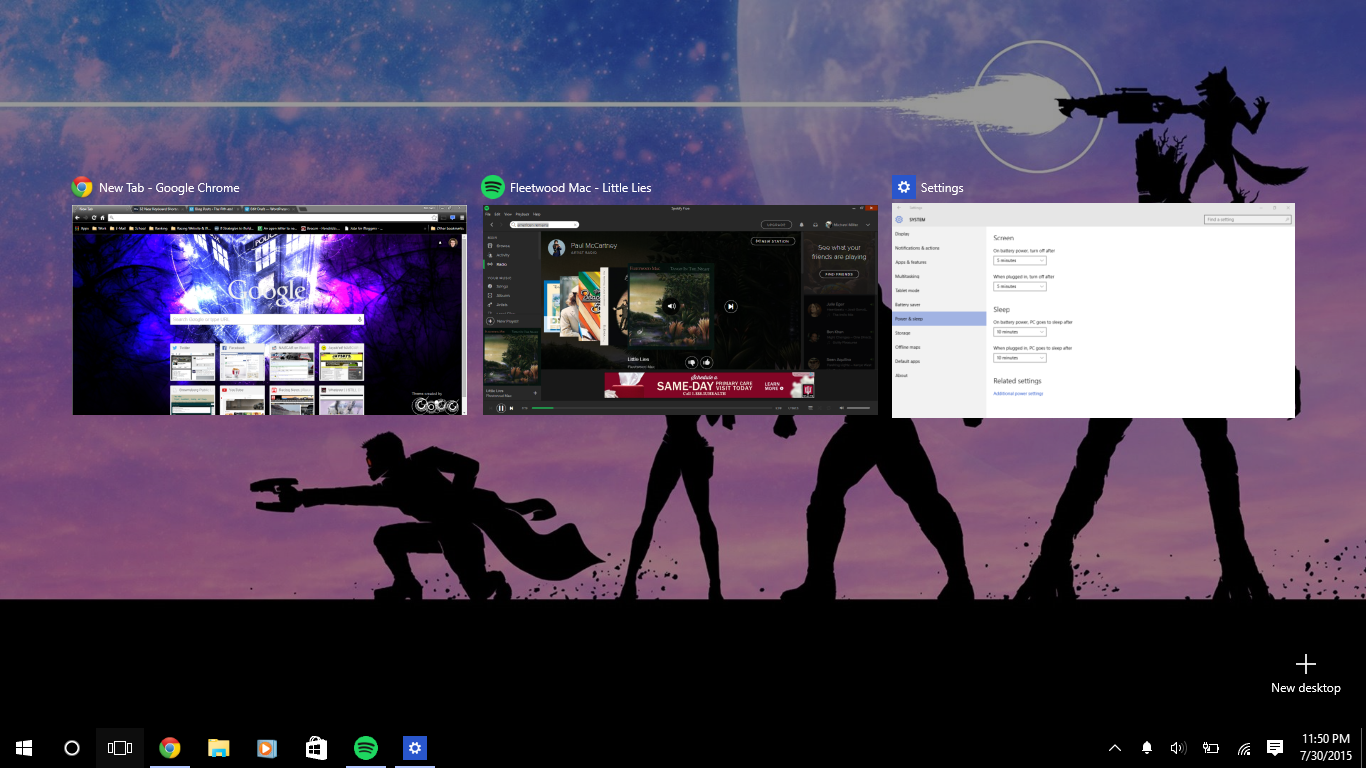
Task View shows all of your open windows.

A functional improvement included in Windows 10 is the new “Task View.” Task View provides an exploded look at all of the open windows. So far, this proves helpful in multitasking situations and  benefits from keyboard shortcuts, which How to Geek outlined here.

Cortana
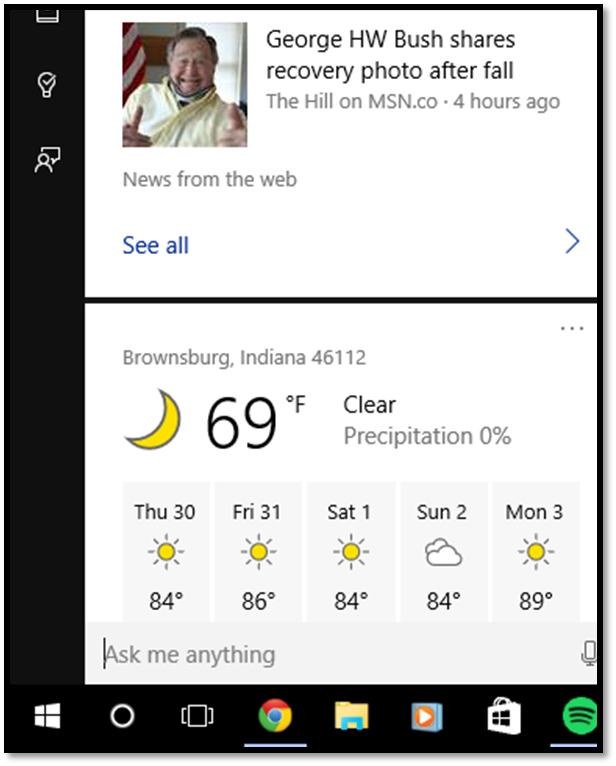
Cortana provides assistance by searching queried items and providing potentially helpful information.

Another point of interest with Windows 10 is Cortana, aptly named after the AI featured in Microsoft’s Halo series. Cortana behaves much like she does on the video games, except she provides more mundane tasks like opening apps or searching a question instead of flying spaceships and opening airlocks.

For anyone familiar with Google’s Google Now experience on Android, Cortana will be quite recognizable. It simply does the same thing, but within the Microsoft ecosystem of Bing and the new Edge browser. However, if you are more of the Google persuasion, Cortana can search through Google Chrome after setting it as the default browser. Also, Cortana will automatically use the Google search engine if you use this plug-in, which is especially helpful to Bing-averse folks like myself.

Despite its popularity within Microsoft’s marketing campaign, Xbox One streaming through Windows 10 serves more as a party trick rather than a legitimate gaming solution. The easiest way to connect a Xbox controller to a PC in this scenario is a simple micro USB cord, though wireless ways are surely available. The streaming function works, yet leaves much to be desired. Obviously, an Xbox game is going to look much better unstreamed on a 32″ HDTV than streaming on a 15″ laptop.

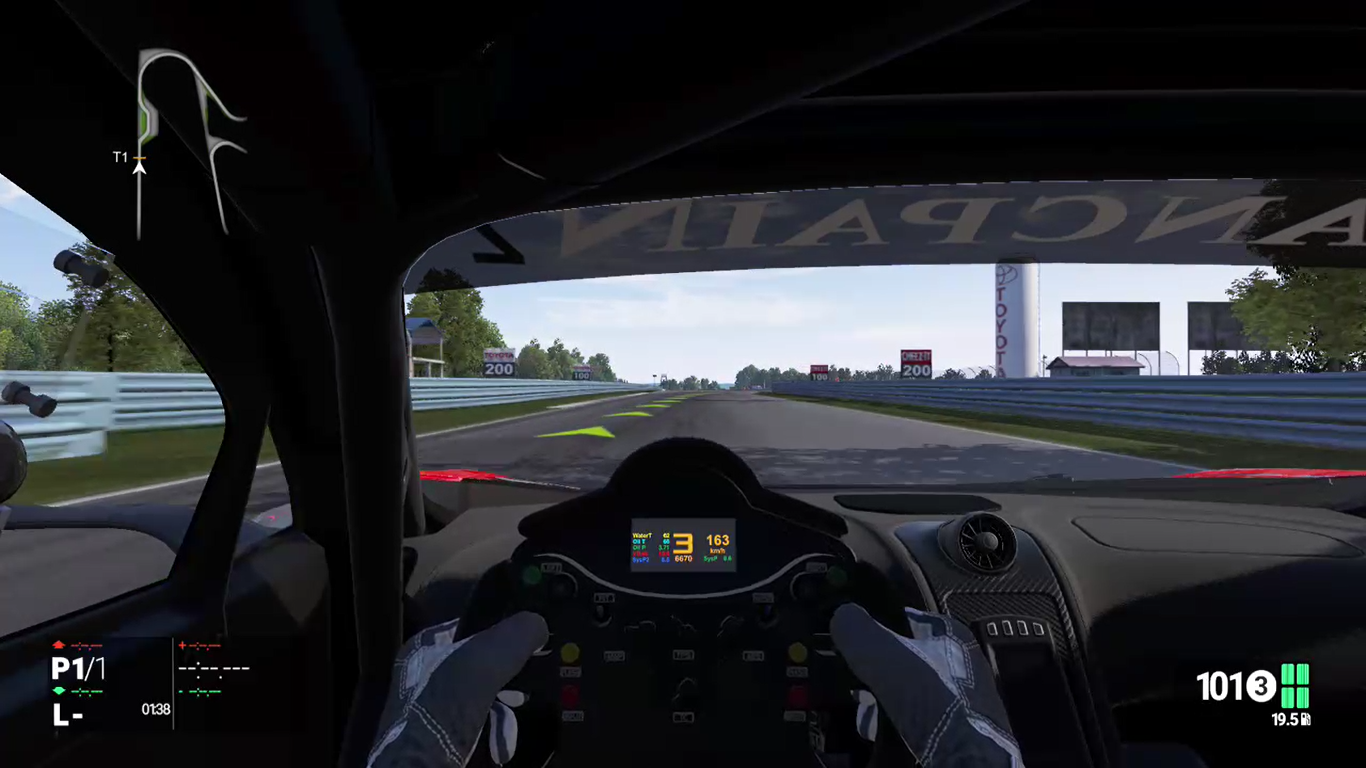
The biggest problem lies within lag between the two machines. When playing Project Cars, I ended up in the weeds because of an ill-timed blip in the stream left me high and dry in a breaking zone. Once again, this streaming feature is a cool trick, but not a sustainable method that hardcore gamers will embrace.

PCarsStream
Project Cars through the Windows 10/Xbox One streaming option. You’ll be better off sticking with gaming on your Xbox, you know, the old-fashioned way.

My biggest gripe with Windows 10 is the problems with the sleep function. After putting my laptop to sleep before making a quick jaunt to the store, the fans whirred as if they were preparing to start as the screen stayed off continuously. After force restarting my PC several times after putting it to sleep, it became perturbing and I went hunting for a solution.

In diagnosing this symptom, it would seem to be a driver issue. However, after updating the video card driver several times, my laptop still necessitated a force restart after being put to sleep. It turns out the issue lies with the power settings. If you are suffering from a similar dilemma as I did, I would suggest trying this forum thread, which proved invaluable in tweaking the necessary settings.

Windows 10 is a fine operating system that is an improvement over its older cousins, but it’s still a work in progress. If you rely on a Windows PC full-time as a work unit, I’d suggest waiting a couple weeks while the trigger happy nerds like myself muddle through smaller glitches and bugs. However, if you are really jonesing to upgrade to Windows 10, go ahead and do it. It’s stable (enough), pretty, and having a new OS is always a joy for your inner nerd.

Jeff Gordon: A worthy pace car driver for the Greatest Spectacle in Racing

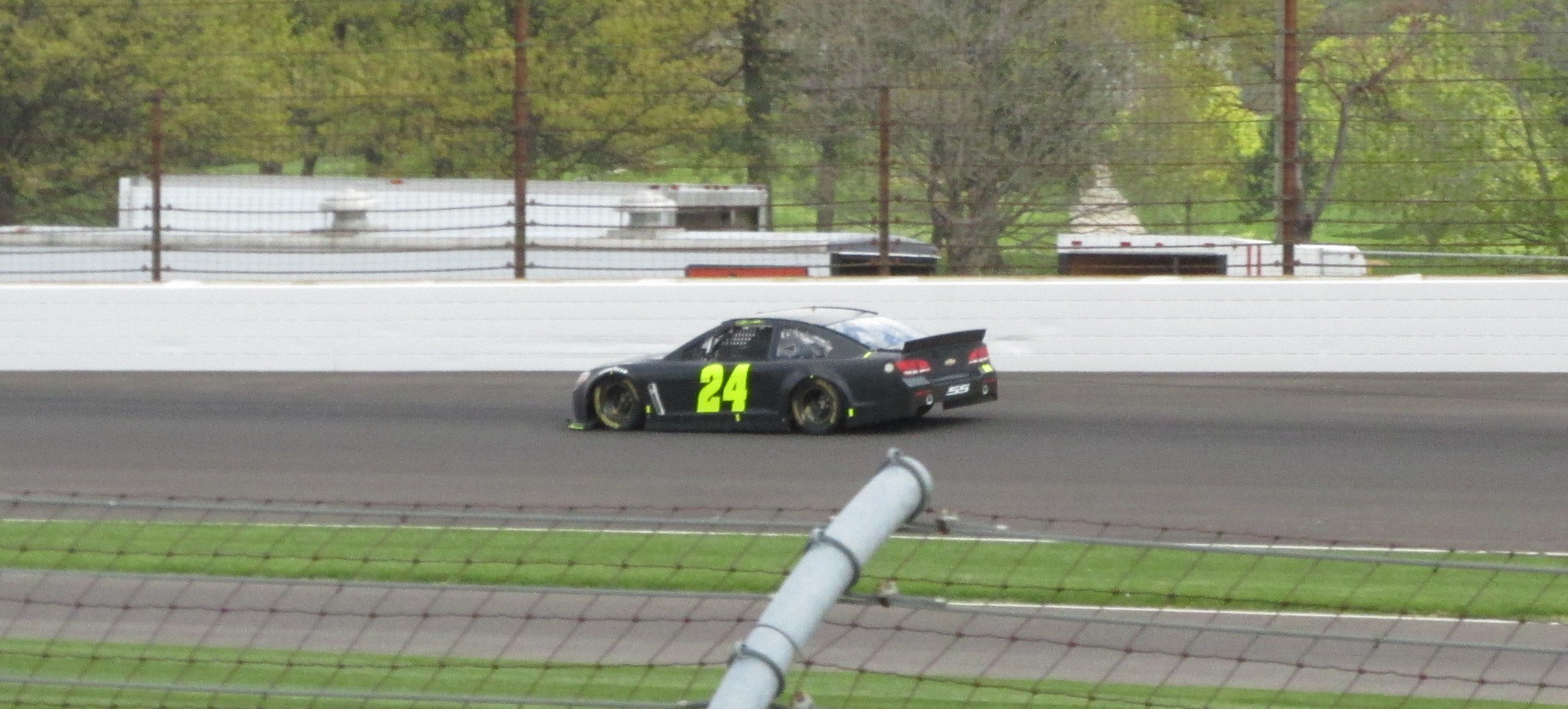
Jeff Gordon tests at the Indianapolis Motor Speedway for a Goodyear tire test on April 29, the same day the track announced he would drive the pace car for the 2015 Indianapolis 500
Jeff Gordon tests at the Indianapolis Motor Speedway for a Goodyear tire test on April 29, the same day the track announced he would drive the pace car for the 2015 Indianapolis 500.

As I stood on the spectator mound in turn two of the Indianapolis Motor Speedway, waiting for stock cars to hit the track for a tire test, I had to do a double take as I scrolled through my phone. Jeff Gordon’s driving the pace car at the 500? 

It seemed like something a third-tier motorsports news site concocted from their “sources.” But as I saw reputable journalists and eventually Gordon himself tweet about it, the news sank in.

At first, I was wary of Gordon’s involvement with the 500. He chose NASCAR over IndyCar before I was even born. Why shouldn’t a legend of the 500 do the honors of driving the pace car, like Arie Luyendyk in honor of the silver anniversary of his first win at Indianapolis? Or even Indianapolis resident and young adult author, John Green?

As I thought about it over the span of the next few hours, Gordon made more and more sense. Not just because of what he means to Indiana, but what he means to motorsports as a whole.

When Jeff Gordon climbs out of his #24 Chevrolet for the final time after the Homestead race in November, racing will be changed for an impressive portion of race fans forever. Just as it was when Richard Petty retired. Just as it was when Dale Earnhardt died.

For a generation, Jeff Gordon was auto racing, especially for a kid growing up on the outskirts of Indianapolis. With the Indianapolis 500 being on the decline and a guy from the next town over dominating the NASCAR circuit, stock car racing seemed to be the higher form of motorsport to a three-year-old version of myself.

Gordon and his Rainbow Warriors paint scheme was a gateway drug for so many young racing fans. His star lead us to new favorite drivers and new disciplines of racing, such as IndyCar racing in my case, all because the DuPont #24 planted a seed in our minds.

And for that, the Indianapolis 500, and motorsports as a whole, owes Jeff Gordon a debt that is impossible to pay.

Remembering Dan

10417782_773760922645268_3148865677633801526_n

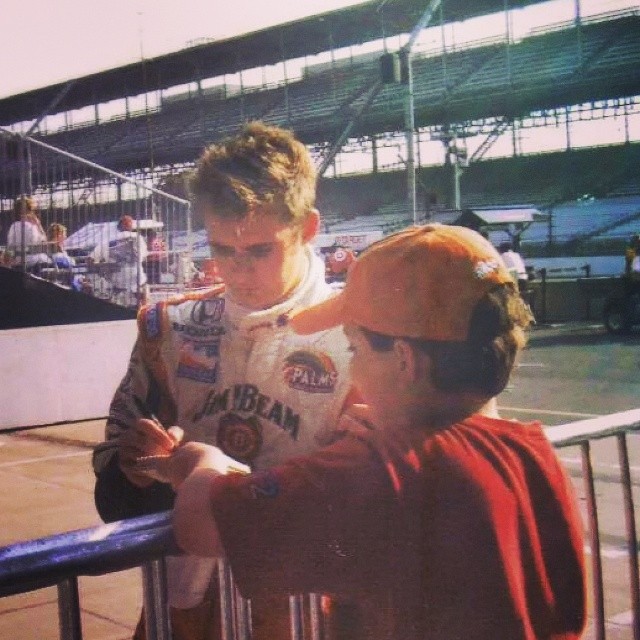
An 10-year old me meets Dan in 2004

My family is coming over today. This means I have to clean my room, a quick once-over to clear surfaces of dust to accommodate my obsessive-compulsive tendencies. I move toward my bookshelf. A book autographed by NASCAR legend Donnie Allison topples over, a result of my shelf’s regurgitation due to over feeding. I sit the book upright, but the force of the others sends Allison’s autobiography down again. I try to find a makeshift bookend to end the battle. The set of 1:64 scale Dukes of Hazzard replica diecast will not do the trick. Nor will the framed picture of my grandfather and me a month or two before he died.

I reach for the heaviest non-paper item on my shelf. It is a set of lugnuts, all from the NASCAR powerhouse of Hendrick Motorsports. I attempt to stack the five lugnuts in a pyramid to test their abilities as bookends. It works. I suppose that if it can hold a wheel on an unwieldy stock car going at a 200 mph clip, it can muster the strength to keep a few books still.

The outside of the nut is yellow, its once bright sheen dulled by the wear and tear of motorsports. A pink residue clings to the bottom of the lugnut; it used to be the glue that mounted the nut to the wheel. The high-powered gun stripped the lugnut, the thread of the lugnut ground down, exposing the metal beneath the yellow finish.

*******

It was a Sunday morning in mid-October. My mom, dad, brother, and I sat around the table, eating breakfast. Today was not any ordinary day. It was the final race of the 2011 IndyCar season and the send-off for the series’ current car. The higher-ups at IndyCar’s 16th & Georgetown offices billed the race as spectacle not to miss. Thirty-four cars entered the race at the 1.5 mile Las Vegas Motor Speedway-one more starter than the Indy 500 traditionally sees.

Advertisements prominently featured Dan Wheldon, the two-time and then-defending Indianapolis 500 winner, the former IndyCar champion, and my favorite driver since he and I shared a moment together more than seven years earlier. Wheldon was running the race as a barnstormer of sorts. He had won the Indianapolis 500 five months earlier, but did not have a seat because of the cruel game of musical chairs that is a sad truth of racing.

Wheldon’s objective for Las Vegas was simple enough: win. He and one lucky fan would win $1 million if Wheldon could do the unthinkable and take victory starting from the final spot on the grid. Wheldon, in his charismatic way, seemed more than happy to take the challenge. His demeanor before the race would not indicate any sort of stress. Thousands of miles away, however, I was not feeling quite so optimistic.

“How do you think the race will go today, Mike?” my mom asked as I poked around my biscuits and gravy.

“I really don’t like this,” I said sheepishly. “Thirty-four cars are just too much. I don’t have a good feeling about this. This could be a bad day.”

********

The race started. I sat alone in my room watching the race, sitting cross-legged on the floor. My dad and brother watched the Colts game in the living room. My mom folded laundry in her room. The tension on-track was palpable. Cars scurried around the track, trying to make best of the limited real estate.

The tenth lap had just begun. The broadcasters shifted their focus to Wheldon and his potential for a huge payday. As the field came around for the eleventh circuit, the ABC broadcast showed Wheldon’s onboard camera. In less than ten seconds, Dan Wheldon would be dead at age thirty-four.

********

“Oh my God. Holy shit!” I yelled from my room. The Colts had just tossed an interception, so my exclamation went unheard in the living room.

I staggered out of my room affected by what I had just seen. I did not know who was involved in the wreck, but I immediately registered the potential for loss of life. I could barely muster a whisper, but I told my dad to turn the television to the race.

The aftermath of the crash looked cataclysmic. Shards of carbon fiber and suspension assemblies lined the banking of the track. After a replay moments later, my dad echoed the same shocked obscenities I had mutter earlier. A graphic comes on the screen, noting the drivers who caught up in what could be lightly called a collision. I sighed as I saw Dan Wheldon’s #77 appear towards the end of the list.

The next three hours were absolute Hell on Earth. I, along with thousands of other IndyCar fans, took to Twitter, desperate for an update on one of the sport’s most charismatic champions. Gossip spread as it does in a social media platform. A genuine-appearing parody account of Ashley Judd, the actress formerly married to multiple-time Indy 500 winner Dario Franchitti, said Wheldon was being treated for minor burns, but would be all right. A bona-fide Associated Press report posted a picture of anxious paramedics loading limp, blanket-covered body aboard a medical helicopter while intubating the patient.

In the uncertainty in the ensuing hours, race fans and drivers prepared for the worst, but prayed for the best. I paced around the house and fidgeted in my seat. It felt like sitting in a waiting room, thought the hospital was on the other side of the country.

At around 7:00 PM on the east coast, the proverbial doctor walked out with the bad news, as IndyCar CEO Randy Bernard sat down for a press conference. Choking on his words, Bernard said what we all feared, but knew deep down: Dan Wheldon was dead. Bernard also announced that IndyCar cancelled the race and the remaining drivers in the race would take their cars around the track for a tribute to Wheldon.

Sobbing drivers hugged their families, friends, and colleagues as they strapped in their cars. The drivers strapped on their helmets, their countenance making it clear that they were not ready to go back out on the race course that just took the life of their brother-in-arms. As the drivers rolled out onto the circuit, they grouped up into the rows of three traditional to the Indianapolis 500, the race that had defined Wheldon six years earlier.

As the cars circle the track, I felt a surge of emotion, one that would change my life forever. My hero was dead. Perhaps it was the fact that the bagpipe-laden rendition of “Amazing Grace” reminded me of Spock’s death in The Wrath of Khan. Maybe thinking about Wheldon’s two young sons and his widow struck a chord with me. Nevertheless, I think it was a feeling of shame and self-loathing that turned me into a sobbing mess. How could I devote so much time and energy in a sport that could be so cruel? One where a single mistake meant not just the agony of defeat, but death, the ultimate defeat.

Wrapped with guilt, I questioned my entire life. For the bulk of my life, I had wanted nothing more than to be a reporter in open wheel and sports car circles. How could I go to work each day, making a living off innocent men and women slogging it out, waiting for their luck to run out? Did I really want to make a living off that barbaric tiding?

As I sat alone in my room, not only mourning my fallen hero, but also pondering my very existence, I picked up a lugnut from the nearby bookshelf. I ran my fingers across the nut, its cold, metallic surface grown down from the abuse of a high-PSI impact wrench. I felt a strange sort of sympathy for the lugnut. It is worn, it is beaten, but it still must do it job. Despite its injuries, it must hold the tire on the car, a duty taken for granted by some yet vitally important. I know the questions I will face tomorrow at school. People know that I loved Wheldon and IndyCar racing. They also know that few (if anyone) at Brownsburg High School would have more expertise on the subject of the crash than I would. I must answer their questions, a job that many do not give a second thought, but one whose absence would be notable.

*********

The day after Dan Wheldon’s death, I went to school, and as expected, I answered questions about the accident, in spite of my own personal torment. In the coming weeks, I would decide to keep writing about the sport I Iove, though the fear and anxiety that came with Wheldon’s death was still there. I interviewed racing figures for my high school newspaper, with the thought of life’s fleeting nature for racers in the back of my head. The story that resulted, as well as my altered perception of the world, a string of strong stories, paving the path for me to become “Staff Member of the Year,” and accepted into IUPUI.

********

It is the Sunday of Memorial Day weekend in 2012. I graduated from Brownsburg High School two days ago. For most eighteen year-olds, this is the crowning moment of their young lives. However, two days later, I one-upped myself, relegating graduation to a mere afterthought in my mind. Today was the day I will attend my first Indianapolis 500. Seven months after the reigning champion of the event passed away, the IndyCar Series makes its return to motorsport’s hallowed grounds to celebrate tradition of the world’s greatest race and the life of a departed friend.

********

In the months following Wheldon’s death, both IndyCar racing and I had changed for the better. IndyCar released its new car, much safer than the last generation. As I grew as a person and a writer, IndyCar added improvements to the new car might have saved Dan Wheldon’s life on that fateful October day. In his memory of the man who helped developed the car, car builder Dallara and IndyCar dubbed the new chassis the “DW12.” The new car added a layer of excitement to both the series and the intrigue Indianapolis Motor Speedway. The tension was palpable.

As I sat in the grandstand on the frontstretch at the Indianapolis Motor Speedway, I pondered the past seven months. When the prerace ceremonies started, Wheldon’s friend, teammate, and car owner Bryan Herta fired up the car Wheldon had brought to victory just a year prior, circling the track in a white and orange car numbered 98.

Though “Amazing Grace” did not ring out across the public address system as it had in Las Vegas a few months earlier, the same emotions I felt the previous October came to a head. So much had changed that it would be impossible to be void of emotions upon the realization. As the tears ran down my cheek on the steamy May day, I wondered to myself if change, regardless how painful it is, ends up being for the best at the end of the day.

If Dan Wheldon did not die on that October day, IndyCar might not have reconsidered the safety of the sport, perhaps after the death of another driver. For me, the tribulations helped me find an inner strength and show me how much I really loved car racing.

I thought again of the Hendrick Motorsports lugnut I held seven months earlier, once again pondering the similarities. Just like a car missing a lugnut, without the catalyst for change, we do not truly know how much we need it.

Note: This post is an altered version of an essay written for an IUPUI English class. It got an “A” if you were wondering.